Handyman Website Checklist: What Every Page Needs to Get Leads
Most handyman websites are missing 3–4 things that cost them leads. Here's the full checklist: pages, trust signals, and the technical stuff Google checks.
Roland Sta Romana
Handyman website specialist · 15+ years in web development
Published
Updated
Read time
6 min
A handyman website needs at minimum: a geo-specific headline, a clickable phone number above the fold, a list of services, a defined service area, real photos, at least a few reviews, and a contact form. Missing any of these is costing you leads.
Most handyman websites look fine on the surface. The logo’s there, the phone number is somewhere, there’s a contact form buried in the footer. But fine doesn’t book jobs.
After building custom websites for handyman businesses across the US and Canada, I keep running into the same gaps. Pages that are missing. Sections buried where no one looks. Trust signals that never made it onto the site. Each gap is a small leak. Together, they’re why a site gets traffic but not calls. (If your site already gets visitors but no calls, these 5 fixes for getting more leads tackle that directly.)
This checklist covers what a handyman website actually needs: the right pages, what belongs on each one, the trust signals that turn visitors into callers, and the technical stuff that affects how Google ranks you.
If you already have a site, run through this. If you’re building one, start here.
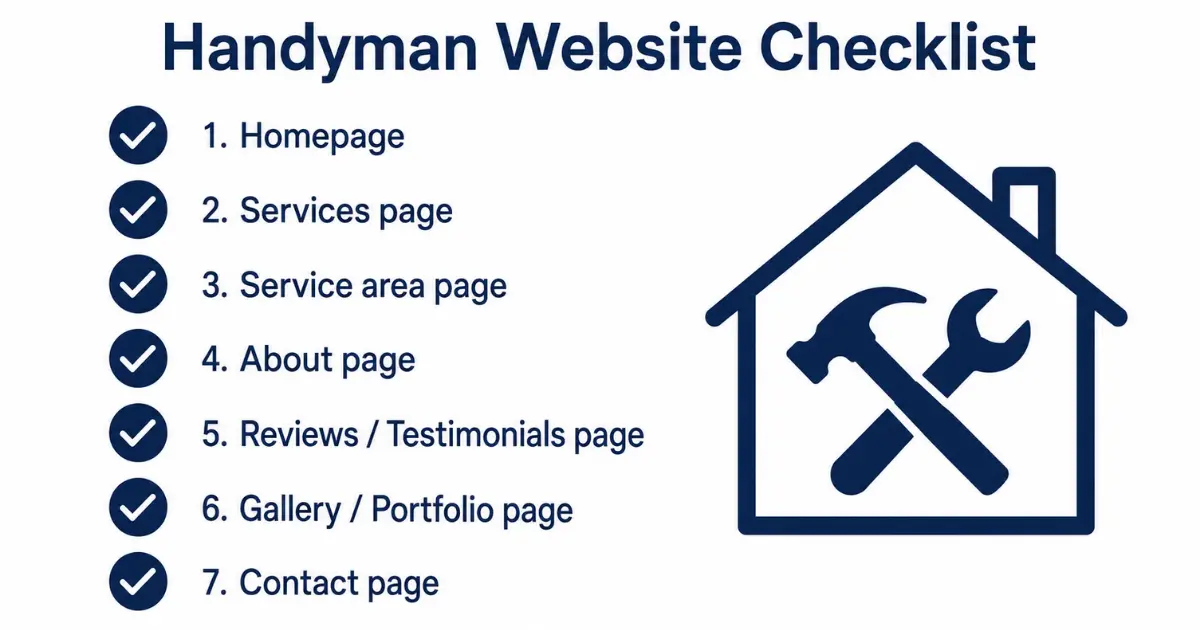
The 7 Pages Every Handyman Website Needs
A tight, well-structured site beats a bloated one every time. Here are the seven pages that actually do work for a handyman business.
1. Homepage
Your homepage is your first impression and your strongest SEO page. It needs to make two things clear within a few seconds: what you do, and where you do it.
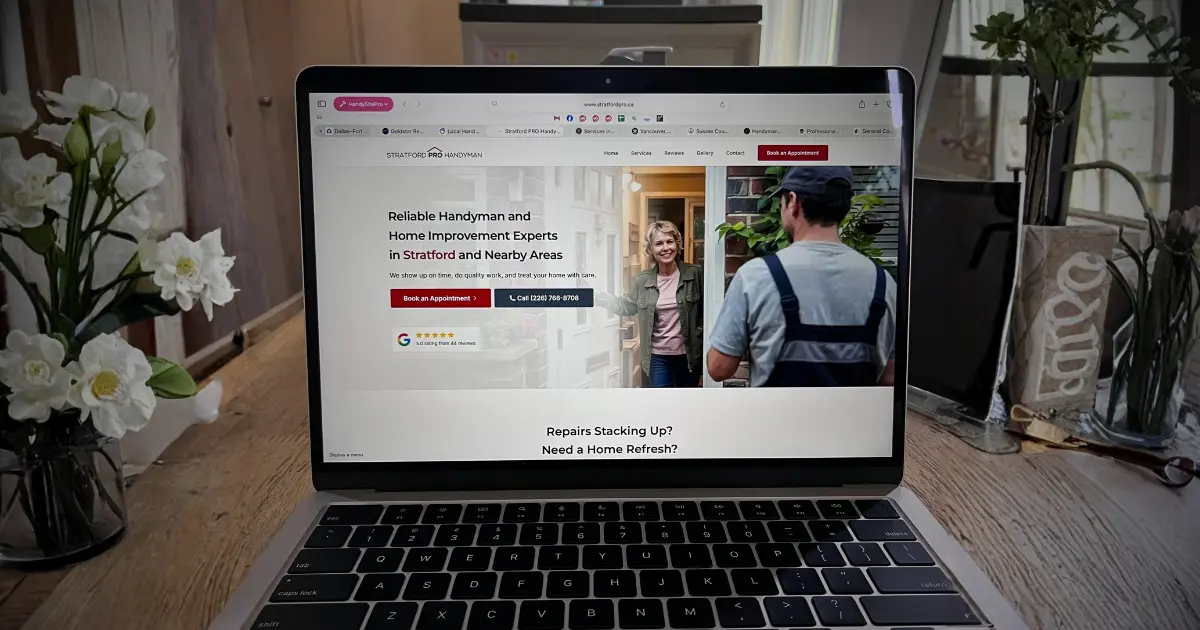
“Welcome to our site” is a dead start. Something like “Handyman Services in Denver: Licensed, Local, Available This Week” tells Google what you are and gives visitors a reason to keep reading.
2. Services page
One page listing every service you offer. Not a wall of text. Short descriptions with a clear layout. People scan, they don’t read.
If your range is wide, it’s worth having a sub-page for your main services (drywall, plumbing repairs, painting, etc.). More pages means more chances to show up in search.
3. Service area page
This is the page most handymen skip, and it’s one of the most valuable for local SEO. List every city, town, and neighborhood you cover. Spell it out. Google uses this to decide whether to show your site to someone in a given location.
4. About page
People hire people, not businesses. A short page with your name, a photo, and a few sentences about your background and how long you’ve been at this builds more trust than any badge or slogan.
5. Reviews / Testimonials page
A dedicated reviews page lets you pull in Google reviews, add written testimonials, and build a page that can rank for “[your name] reviews” searches. Even five or six good ones make a real difference.
6. Gallery / Portfolio page
Before-and-after photos, finished jobs, anything that shows your work. Homeowners want to see what they’re getting before they call. Real photos of real work beat stock images every time. For inspiration, see these handyman website examples that get leads.
7. Contact page
A dedicated contact page with a form, your phone number, and your service area spelled out. Not just a footer link. Not just an email address. A real page that makes it easy to reach you.
What Every Page Must Include
Having the right pages isn’t enough. Each one needs a few things that most handyman sites skip.
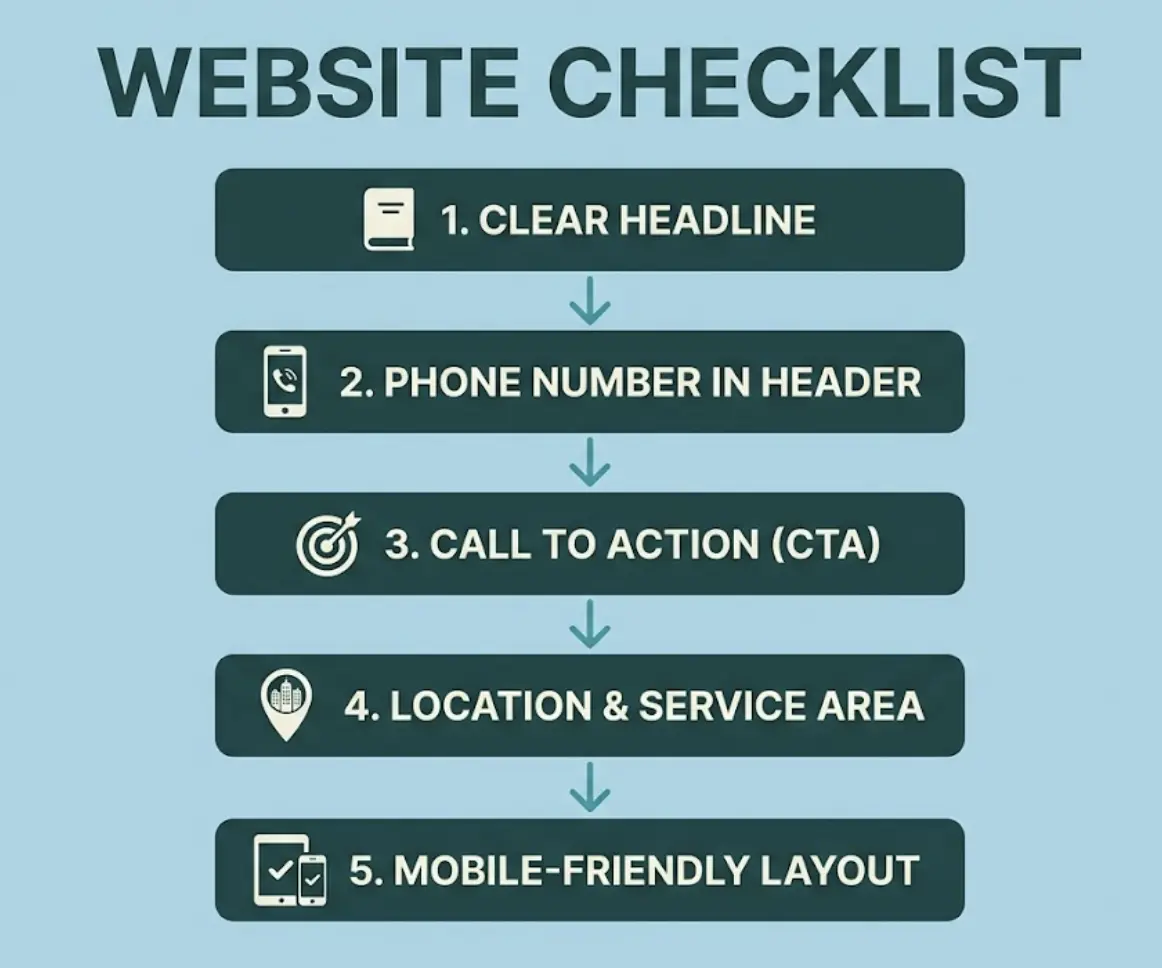
Must-have elements on every page of a handyman website
A clear headline. Every page should open with a heading that says what the page is about. Not clever, not vague. Direct.
Your phone number in the header. Visible on every page, at the top, clickable on mobile. A phone number buried in the footer is basically hidden.
A call to action. Every page should tell the visitor what to do next. “Call for a free quote.” “Get in touch.” “Book a visit.” One clear direction is enough.
Your location. Your city and service area should appear on every page: in the header, the footer, and the body copy where it fits naturally. This reinforces your local relevance to Google.
A mobile-friendly layout. More than half your visitors are on a phone. If your site looks cramped or broken on mobile, they’re gone.
The Trust Signals That Convert Visitors Into Callers
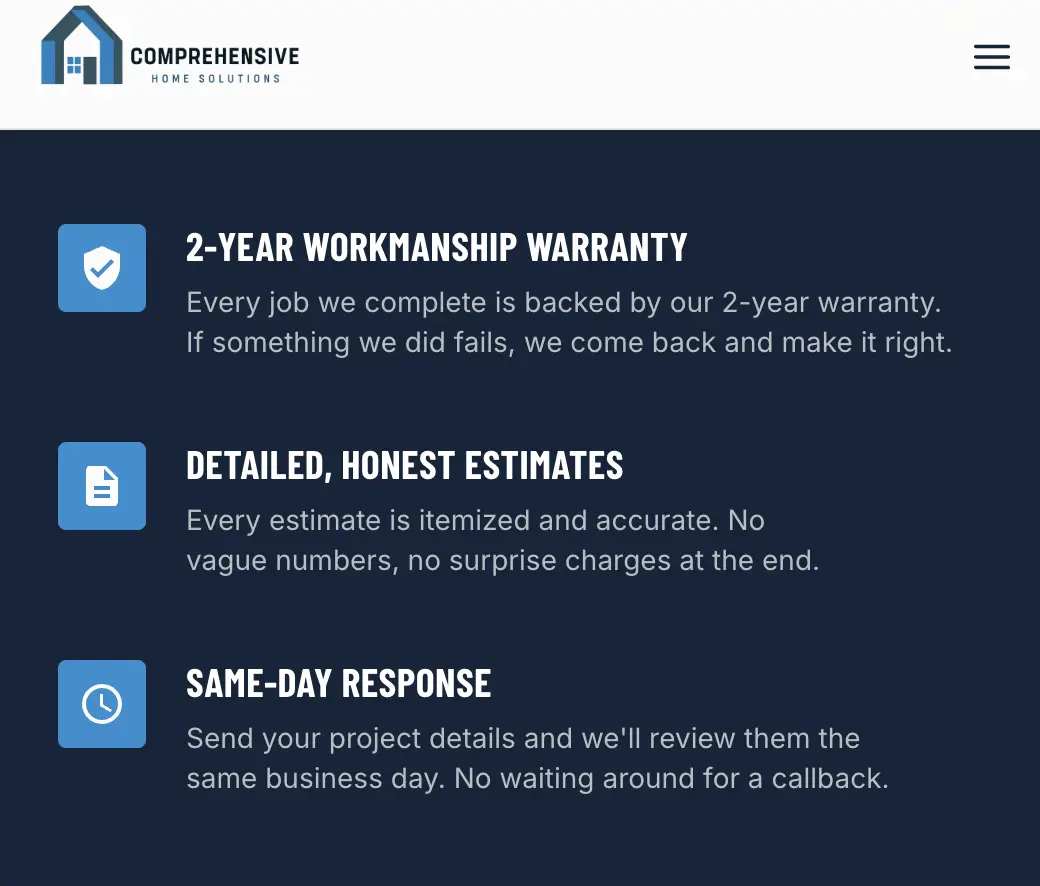
Traffic without trust doesn’t book jobs. These are the elements that make a stranger comfortable enough to pick up the phone.
Real photos of you and your work. A headshot, your truck, a finished project. Anything that proves a real person runs this business. Stock photos of generic contractors don’t do this.
Google reviews on the page. Don’t make visitors go look you up. Pull quotes from your Google Business Profile directly onto your homepage and reviews page.
Specific service areas. Listing “Denver, Aurora, Lakewood, Centennial” tells the reader they’re in the right place. “Greater Denver Area” tells them nothing useful.
License or insurance mentioned. Even one line: “Licensed and insured in Colorado” removes a big hesitation for homeowners who’ve had bad experiences before.
A response time expectation. “I respond to all inquiries within a few hours” or “Same-day quotes available” cuts the uncertainty of reaching out. People want to know they won’t wait a week to hear back.
Trust signals that turn visitors into callers
The Technical Stuff That Affects Your Google Ranking
You don’t need to understand all of this. But whoever builds your site should be handling it.
Page speed. A slow site gets penalized by Google and abandoned by visitors. On mobile, if your site takes more than three seconds to load, you’re losing people before they see a single word. Custom-coded sites load faster than WordPress or Wix sites weighed down with plugins and extra scripts.
HTTPS. Your site should load with https:// not http://. Most hosts include an SSL certificate free now, but double-check. Google labels non-HTTPS sites as “Not secure.” That’s enough to make visitors leave.
Title tags and meta descriptions. Every page needs a unique title tag and meta description. If they’re missing or duplicated across pages, you’re leaving ranking potential on the table.
Schema markup. Structured data that tells Google exactly what your business is: a local service, your hours, your location, your reviews. Invisible to visitors, but it helps Google understand and display your site correctly.
A sitemap submitted to Google Search Console. This tells Google what pages your site has and helps them get indexed faster. A new site without this can sit unnoticed for months.
Frequently Asked Questions
How many pages does a handyman website need?
At minimum, five: homepage, services, about, contact, and a service area page. Seven pages covers everything needed to rank locally and convert visitors into clients.
What should be on the homepage of a handyman website?
A clear headline with your location, a brief list of services, your phone number at the top, a few reviews, and a contact form or button. Everything a visitor needs to decide whether to call you.
Does a handyman website need a service area page?
Yes. It’s one of the most valuable pages for local SEO. Without it, Google doesn’t know where you work and you’ll miss searches from people in your target cities.
How important are reviews on a handyman website?
Very. Displaying reviews on your site removes friction. A visitor who sees real testimonials before calling is far more likely to follow through than one who has to go search for them separately.
What makes a handyman website load slowly?
Large uncompressed images, too many plugins, and bloated page builders are the main culprits. A custom-coded site avoids most of these by design.
A handyman website missing half this list will look fine to you and do nothing for your business. The sites that actually generate calls aren’t always the prettiest. They’re the most complete.
That’s what HandySitePro’s handyman website design service builds. Every site comes with 7 pages, custom-coded from scratch, built around local SEO from day one. No templates, no WordPress, no plugin headaches.