How to Find the Right Web Designer for Your Handyman Business
Not every web designer understands handyman businesses. Here's what to look for, what to ask, and the red flags that cost you money.
Roland Sta Romana
Handyman website specialist · 15+ years in web development
Published
Read time
7 min
Look for a web designer who has built sites specifically for handyman or home service businesses, can show you real examples that rank in local search, and quotes a clear price with no surprise costs. A generalist builds something that looks fine. A specialist builds something that gets you calls.
Most handymen who contact me have already been burned once.
They paid someone to build a website. It looked decent. Then nothing happened. No calls from Google, no new customers, just a site sitting there while they kept relying on word of mouth.
The problem usually wasn’t the price they paid. It was who they hired.
A web designer who builds restaurant websites, portfolio sites, and online stores is not the same as someone who builds local service business websites. The skills overlap. The strategy doesn’t.
Handyman websites need to win in local search. That is a specific job most generalist designers don’t spend much time on.
Here’s how to find someone who actually knows what they’re doing.
The First Question to Ask Any Web Designer
Before you talk about price, timelines, or what your site should look like, ask this:
“Have you built websites for handyman or home service businesses before?”
If the answer is yes, follow up with: “Can you show me examples that are ranking in local search right now?”
That second question is where most designers fall apart. Showing you a pretty website is easy. Showing you a website that appears when someone in that city types “handyman near me” is a completely different thing.
A designer who specializes in handyman websites will pull up real examples, tell you what city they’re in, and let you check the rankings yourself. If they can’t do that, they’re not who you’re looking for.
What a Handyman Website Actually Needs
This is where generalist designers lose the plot.
They’re thinking about design. You need to be thinking about leads.
A handyman website isn’t a brochure. It’s a lead generation tool. To work as one, it needs things generic web designers don’t always prioritize.
Location-specific pages. If you serve five cities, you need five pages, each one written around that city’s name and the services you offer there. One generic “service area” paragraph doesn’t cut it for local SEO.
Fast load times on mobile. Over half of all searches for local services happen on a phone. A site that takes four seconds to load on mobile is costing you jobs. Custom-coded sites load faster than sites built on WordPress or Wix with a pile of plugins.
A visible phone number above the fold. Not buried in the footer. At the top of every page, clickable, so someone on their phone can call you in one tap.
Real trust signals. Reviews with names. Photos of actual work. A photo of you. Stock images and generic copy don’t convince anyone to hand over their house key.
Ask any designer you’re considering how they handle local SEO for service area businesses. Their answer will tell you a lot. If you want the full list, run your site through the handyman website checklist.
If a customer has to scroll to find your phone number, most of them won't.
Red Flags to Watch For
Some of these will save you a lot of money and frustration.
They can’t show you handyman or contractor sites they’ve built. Portfolio matters. If every site they show you is a restaurant, a photographer, or an online store, they don’t have the experience you need.
They want to build on a platform you don’t control. Some designers build your site inside a proprietary system you can’t take with you. Ask directly: if I stop working with you, do I own the site and its content? You should never be locked in.
They promise page one rankings quickly. Nobody can guarantee Google rankings. Anyone who says otherwise is either lying or selling you something you don’t want. Local SEO takes three to six months to show real movement. A good designer sets honest expectations.
They quote you a price without asking about your goals. A designer who jumps straight to pricing without asking what cities you serve, what services you offer, and how you currently get leads doesn’t have enough context to build you something that works.
They lean on templates. Templates are fast and cheap. They’re also the same thing your competitors already have. A site that looks like every other handyman site in your city won’t stand out in search results or build much trust.
What a Specialist Looks Like in Practice
The difference between a generalist and a specialist is simple.
A generalist builds websites. A specialist builds lead generation systems for handyman businesses.
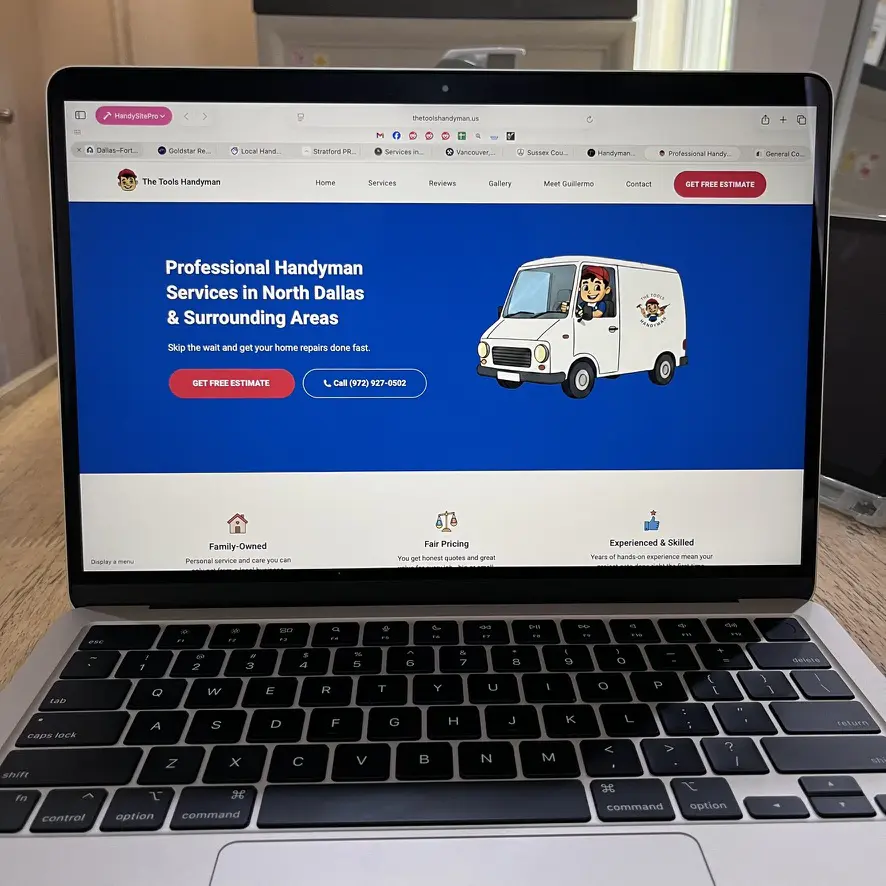
Here’s a concrete example. When I built the site for The Tools Handyman in North Dallas, we didn’t just list services on one page. We grouped everything into four categories, remodeling, plumbing, carpentry, and general repairs, and gave each category five dedicated sub-service pages.
That structure isn’t a design choice. It’s an SEO one. Each of those twenty pages can rank on its own for a specific search like “faucet installation Garland TX.” A generalist would have put all of it in a single bulleted list and moved on.
That’s what handyman website design looks like when it’s built for the trade instead of adapted from a template. Every site I build is custom-coded from scratch, which means faster load times, cleaner code, and no plugin maintenance headaches.
One homepage section quietly creating twenty chances to show up in local search.
A short list worth running through with any designer before you commit:
Do you have examples of handyman or contractor sites that rank in local search?
This is the most important question. Ask to see the site, search for it yourself, and verify the ranking.
Who owns the site and the content after launch?
You should never be stuck. Domain, content, and the ability to walk away should all be clear before you pay anything.
What happens if I want to change something after launch?
Find out if edits cost extra, how long they take, and whether support is included.
How do you handle service area pages?
A designer who understands local SEO will have a clear answer. A generalist will look confused.
What does the price include?
Get a clear list. Copy, images, hosting, setup, revisions. Vague proposals lead to surprise invoices. For context on what’s normal, see how much a handyman website should cost.
Frequently Asked Questions
How much should I expect to pay for a handyman website?
Freelance specialists typically charge $1,500 to $2,500 as a one-time build fee. Agencies charge more, usually $3,000 to $10,000 or higher. DIY builders like Wix cost $16 to $45 a month but require your time and limit your local SEO options. HandySitePro works differently, at $299 setup plus $29 a month with hosting, domain, and updates included.
How long does it take to build a handyman website?
A specialist who focuses on handyman businesses can typically deliver a finished site in one to four weeks. Larger agencies take longer. DIY builders let you go live immediately, but the setup time to do it properly is usually ten to twenty hours of your own work.
Do I need a local web designer or can I hire someone online?
You don’t need someone in your city. What matters is that they understand the handyman trade and local SEO, not that they’re down the road. A specialist who has built handyman websites across multiple cities will usually outperform a local generalist.
What’s the difference between a website designer and a web developer?
Designers focus on how a site looks. Developers focus on how it’s built. For a handyman business you want someone who handles both, because code quality directly affects how fast your site loads and how well it ranks.
Can a web designer also handle my Google Business Profile?
Some do, some don’t. Ask upfront. Your Google Business Profile and your website work together for local SEO, so it helps to work with someone who understands both, even if they don’t manage the profile directly.
The right web designer for your handyman business isn’t the cheapest one or the one with the flashiest portfolio. It’s the one who understands what you actually need: a site that shows up in your city when someone needs a handyman, and makes it easy for them to call you.
That’s what HandySitePro is built around. Custom-coded websites for handyman businesses, no templates, no WordPress, no ongoing plugin headaches. Just a fast, clean site designed to rank locally and turn visitors into calls.