local seohandyman websitegoogle searchgoogle business profile
Why Your Handyman Website Isn't Showing Up on Google
Built a website and still invisible on Google? Here are the real reasons handyman sites don't rank, and how to work out which one is your problem.
Roland Sta Romana
Handyman website specialist · 15+ years in web development
Published
Read time
8 min
Usually it's one of five things. The site is too new, Google hasn't indexed it, there's no location on your pages, your Google Business Profile isn't connected properly, or the site is too slow. Most handyman sites that aren't ranking have a specific fixable problem, not a mysterious one.
You paid for a website. It looks good. You’ve been waiting.
Nothing.
You search your own business name and you’re not there. You search “handyman in your town” and you’re definitely not there. Meanwhile some guy with a site that looks like it was built in 2011 is sitting in the top three.
It’s a maddening feeling, and I hear about it constantly.
The good news is that this is almost never a mystery. There’s a reason, it’s usually one of about five, and most of them you can check yourself in the next twenty minutes.
Let’s work through them in order.
First: Is Google Even Aware You Exist?
Before anything else, check whether Google has your site in its index at all.
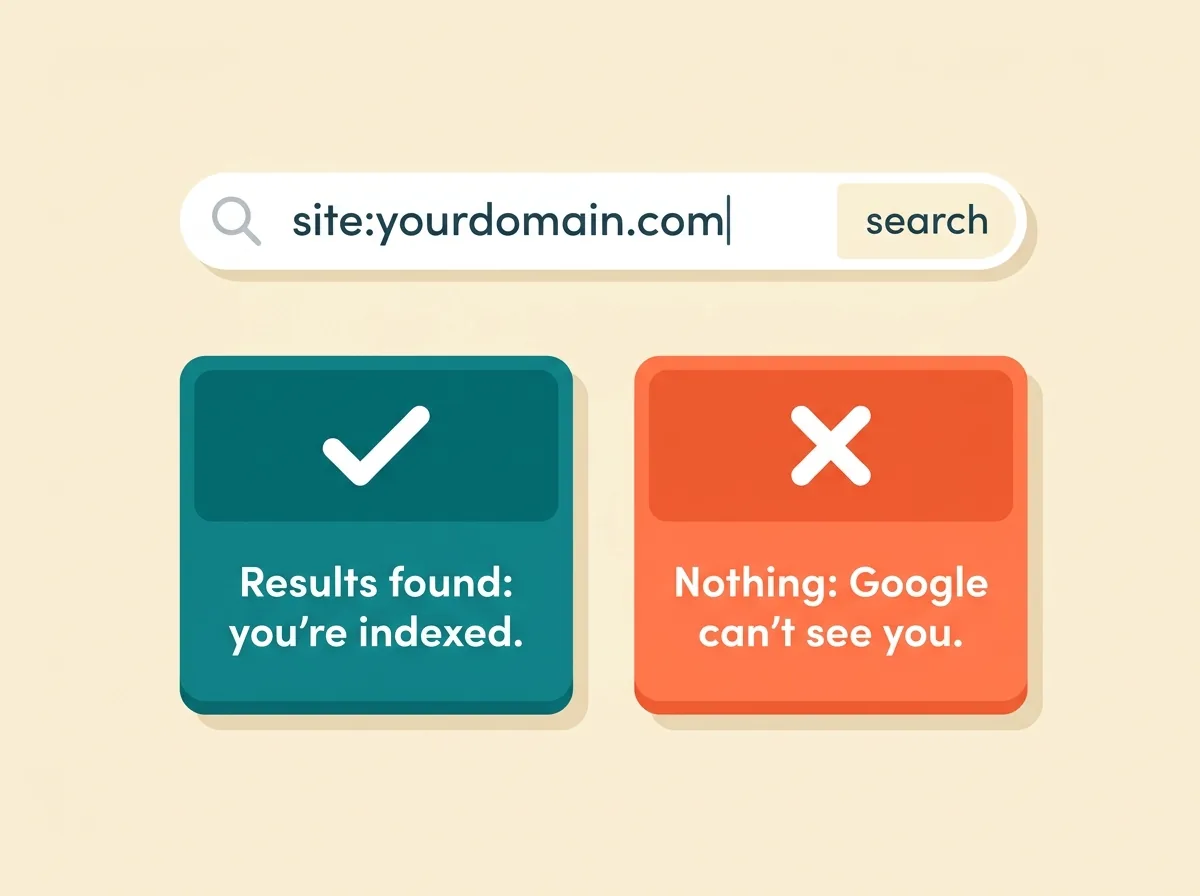
Open Google and type this, using your own domain:
site:yourdomain.com
If results come back, you’re indexed. Google knows about you. Your problem is further down this list.
If nothing comes back, that’s your answer right there. Google has never properly crawled your site. Nothing else matters until that’s sorted.
How it gets fixed: set up Google Search Console, submit your sitemap, and request indexing on your main pages. It’s free and it takes about fifteen minutes. If whoever built your site never did this, that’s a conversation worth having with them.
Thirty seconds to find out if Google knows you exist.
Second: How Old Is the Site, Honestly?
If your site launched six weeks ago, I have slightly annoying news.
That’s normal. Nothing is broken.
A brand new domain takes roughly three to six months before it starts ranking properly in local search. Google is cautious with sites it hasn’t seen before. It wants to see that you’re still around, that the content stays put, that other signals line up.
There’s no trick that skips this part. Anyone selling you one is selling you something else.
What actually helps during the wait: get your Google Business Profile sorted, collect reviews, make sure your site is technically clean so that when Google does start trusting you, there’s nothing holding you back.
If your site is over six months old and still nowhere, then yes, something is genuinely wrong. Keep reading.
Third: Does Your Site Say Where You Are?
This one catches more handyman sites than anything else.
Go look at your homepage right now. Read the first line of text, the big headline at the top.
Does it name your town?
An enormous number of handyman sites say something like “Quality Home Repairs You Can Trust” or “Welcome to Dave’s Handyman Service.” Nice sentiments. Completely useless to Google.
Google has no idea where you work unless you tell it, repeatedly and clearly. “Handyman Services in Boise, Idaho” tells it everything. “Welcome to our website” tells it nothing.
Where your location needs to appear:
The main headline on your homepage. Your page titles, which is the text showing in the browser tab. Your meta descriptions. Your headings throughout the site. Naturally within your body copy. Your footer, alongside your phone number.
And if you cover more than one town, each one needs its own page. A single sentence listing eight towns does not rank you in eight towns. Eight actual pages might.
Fourth: Is Your Google Business Profile Connected and Complete?
Your website and your profile are supposed to back each other up.
Google cross-checks them. Same business name, same phone number, same address or service area, website linked from the profile, profile effectively vouching for the site.
When those don’t match, Google gets uncertain, and uncertainty is not how you end up in the map box.
Worth checking:
Is your website actually linked on your Google Business Profile? A surprising number aren’t.
Does your business name match exactly, right down to whether you use “and” or ”&”?
Is the phone number identical in both places?
Does your service area on the profile line up with the towns your site claims to cover?
If you haven’t touched your profile since you first set it up, that’s very likely part of this. It’s also the single fastest thing on this list to fix. Our Google Business Profile setup guide walks through it step by step.
When these two agree with each other, Google gets more confident about you.
Fifth: How Slow Is It, Really?
Page speed affects rankings. Google has confirmed this openly.
Go to pagespeed.web.dev and put your URL in. Look at the mobile score, not desktop. Mobile is where your customers are.
Above 90 is strong. Between 70 and 90 is acceptable. Under 70 is actively costing you.
Most sites built on WordPress with a pile of plugins, or on drag-and-drop builders, land somewhere in the fifties and sixties on mobile. That’s not a small disadvantage.
Speed also costs you on the other end. People bail on slow pages. So you’re ranking lower and losing the few visitors you do get, at the same time.
This one isn’t always a quick fix. Sometimes it’s oversized images, which is easy. Sometimes it’s the platform itself, which isn’t.
The Less Obvious Stuff
If you’ve worked through all five and you’re still stuck, a few other things are worth ruling out.
Your site might be telling Google to ignore it. Developers sometimes block search engines while a site is being built and forget to unblock it at launch. It happens more than you’d think. A single line in your robots.txt or a stray noindex tag can keep you invisible indefinitely.
You might have no backlinks at all. If no other website on the internet has ever linked to yours, Google has very little reason to trust you. Local directories, your chamber of commerce, supplier sites, trade associations. A handful is enough to start.
Your details might be inconsistent across the web. If Yelp has your old phone number and your website has your new one, that mismatch chips away at Google’s confidence. Pick a format for your name, address and phone number, then make everything match.
You might be competing somewhere genuinely brutal. Ranking in Dallas is a different proposition to ranking in a town of twelve thousand people. If you’re in a big metro, focus on your specific suburb before you try to take the whole city.
How to Work Out Which One Is You
Fifteen minutes, in this order.
Run the site: search. Not indexed means stop here and fix that first.
Check when the site launched. Under six months means be patient and keep building.
Read your homepage headline. No town name means fix that today.
Open your Google Business Profile. Not complete, not linked, or not matching means fix that this week.
Run the PageSpeed test. Under 70 on mobile means you’ve got a speed problem.
Whichever one trips first is your most likely culprit. Start there before worrying about the rest.
When It’s the Site Itself
Sometimes you go through all of this and the honest conclusion is that the site was never built to rank.
The signs are fairly consistent. No location in the headline. One page covering every town you serve. A mobile speed score in the fifties. No way to add proper pages without wrestling the platform. Built on a template that fights you every time you try to change something structural.
None of that is your fault. Most web designers build sites that look good, because that’s what people ask for. Very few build them around local search, because most of their clients aren’t local service businesses.
That’s the entire reason handyman website design as a specialty exists. Location in the headline, a real page for every town, fast on mobile, structured so Google can read it properly. Built in from the start, not bolted on later.
Frequently Asked Questions
How long before a new handyman website shows up on Google?
Indexing usually happens within a few days to a couple of weeks if the site has been submitted properly. Actually ranking for local searches takes three to six months, longer in competitive cities.
Why does my website show up when I search my business name but not for “handyman near me”?
Appearing for your own name just means Google has indexed you. Ranking for competitive local searches needs location signals on your pages, a complete Google Business Profile, reviews, and time. Those are different problems.
Can I check whether Google has indexed my site myself?
Yes. Search site:yourdomain.com in Google. If pages come back, you’re indexed. If nothing does, Google hasn’t crawled your site and that’s the first thing to fix.
Does page speed really affect my Google ranking?
Yes, particularly on mobile. Google uses page experience signals as a ranking factor. Test at pagespeed.web.dev and aim for 90 or above on mobile.
Do I need a separate page for every town I work in?
If you want to rank in each of them, yes. A single sentence listing several towns is a much weaker signal than a dedicated page for each one with its own headline and content.
My website is two years old and still isn’t ranking. What now?
At two years old, time isn’t the issue. Work through the five checks above. In most cases it comes down to missing location signals, an incomplete Google Business Profile, or a technical problem like a noindex tag that was never removed.
A website that isn’t showing up on Google almost always has a specific reason behind it.
Run the five checks. One of them will usually point straight at the problem, and most of what you find is fixable in an afternoon.
What you shouldn’t do is keep waiting and hoping. Six months of silence is data, not bad luck.